Envoyez-nous un email :
info@labcompanion.cn
-

-

Demander un appel :
+86 18688888286

In reliability test laboratories that have been in operation for years, a common pain point persists: temperature curves run continuously on the chamber display, yet by the end of each month for quality review, all data remains trapped locally on individual units. Staff must manually record data one by one, compile spreadsheets and share them with production teams. The hardware itself functions properly. The root issue is that these chambers have long operated as standalone tools: data collection lacks standardized protocols and real-time upload capability, keeping them separated from the main production workflow. In 2026, as rapid thermal cycling chambers are deployed directly onto production line workstations, network integration is no longer an optional add-on — it has become a fundamental requirement.
Production lines undergo frequent product changeovers. Test profiles must be retrieved and switched quickly by part number, eliminating on-site manual programming. Profile storage capacity, access logic and switching speed directly reduce changeover downtime.
Every test run must be tied to the corresponding production batch, equipment ID, test profile, temperature curve and pass/fail result to form a closed traceability chain. A missing link breaks the entire audit trail.
Chambers must accept scheduling commands from host systems: receive test jobs, report operational status and push alarm notifications. This capability is especially critical for highly automated semiconductor fabs.
Managers need live access to test progress and equipment status instead of relying solely on on-site patrols. Remote monitoring is only possible when test data can be reliably exported from the unit.
These four requirements converge on one baseline standard: whether the chamber can act as a standardized node on the factory data network. Manual entry was acceptable when test equipment sat in dedicated labs with dedicated operators. Once test stations are embedded into production and linked to production scheduling, manual work becomes a bottleneck to line throughput.
Network-enabled test chambers from Lab Companion are built around the H-Touch industrial touchscreen controller, equipped with a 7-inch color display. The system supports up to 1,200 segments for thermal cycling programming and automatically captures and stores real-time temperature profiles.
The number of program segments defines the ability to execute complex thermal profiles. The 1,200-segment capacity supports multi-step ramps, dwells and nested cyclic test sequences. Combined with automatic curve logging and USB export, it ensures data integrity even during network outages.
Without solid local control and data retention, networking only accelerates the transmission of incomplete data — a frequently overlooked factor during equipment selection.
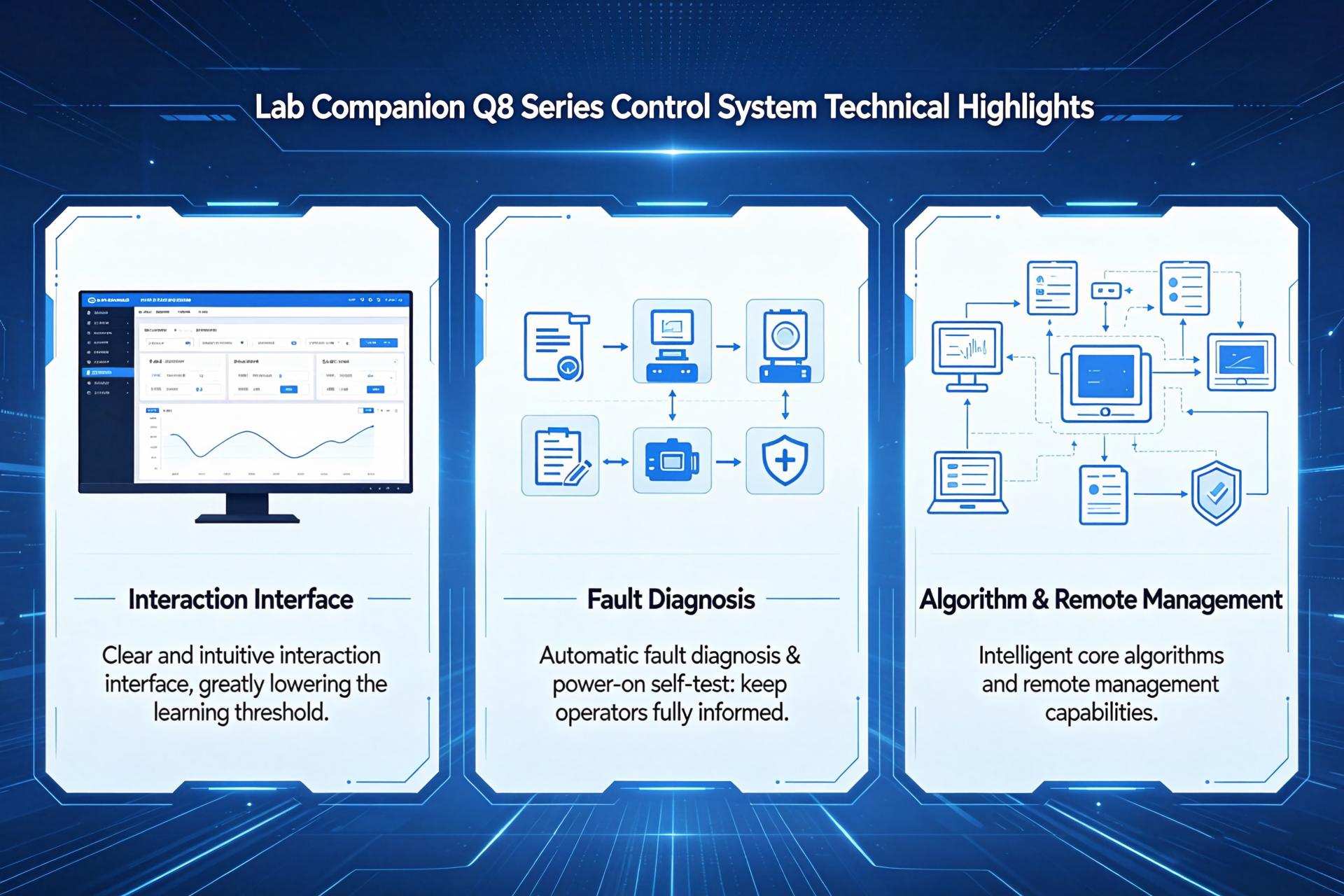
The chamber standardizes and consolidates outputs including temperature profiles, actual ramp rates, dwell durations, test verdicts and alarm logs, avoiding fragmented, inconsistently formatted data scattered across separate screens.
Units come standard with RS485 and Ethernet ports for live data upload, removing manual file copying. RS485 can integrate with legacy laboratory control networks, while Ethernet is the preferred option for new automated production lines.
Via universal protocols such as OPC UA and Modbus TCP, chambers connect directly to factory MES. For semiconductor wafer and packaging fabs, custom SECS/GEM communication is available to link with EAP platforms for fully automated scheduling.
This entire data pipeline relies on proven, field-deployed engineering solutions rather than features still on the product roadmap. During procurement, verify available, deliverable interfaces instead of future development plans.
Once uploaded, batch records, equipment IDs, test profiles, curves and results are automatically correlated inside MES. Users can pull temperature curves by production batch or trace batches backward from test logs, replacing manual logbook searches with one-click system queries.
The chamber supports barcode scanning for batch entry. Upon test completion, a PDF report with pass/fail determination is generated automatically. This shifts manual report compilation to the device level and eliminates transcription errors.
Running status, program progress and fault alerts are pushed live to host systems. For continuous-flow production, alarm timeliness directly controls unplanned downtime. Early anomaly detection substantially reduces the risk of sample scrap.
In wafer fabs and packaging lines, thermal chambers are not isolated stations. They function as automated nodes governed centrally by EAP. Through SECS/GEM, the host sends test jobs, specifies profiles and batch IDs, and the chamber executes commands while feeding back status.
Deviations such as over-temperature, door-open events and compressor faults are transmitted as standardized messages to the host. The system can then adjust scheduling or trigger maintenance workflows with far faster response than manual patrols.
When reliability testing is incorporated into automated scheduling, it is no longer an ad-hoc side task but a defined step within the production schedule. For capacity-constrained semiconductor lines, this predictability itself delivers meaningful throughput gains.
Older installed chambers usually only support local storage. Each unit must be audited individually to confirm whether its controller supports protocol extension and has an available Ethernet port. Some models can be upgraded with communication modules, while older hardware cannot be retrofitted. Audit existing interfaces first; this approach is more cost-effective than blindly purchasing gateways.
Parameter naming conventions between the chamber and MES often differ, including labels, verdict codes, units and precision rules. A standardized field mapping table must be finalized before go-live to define the source, conversion logic and specifications for every data point. Without proper mapping, uploaded data cannot support business operations.
Test chambers typically reside on separate laboratory networks, logically or physically isolated from the production LAN. Cross-network integration requires defined data flow directions, port whitelisting and access permissions. Involve the IT team at an early stage.
The value of networking lies not in the chamber hardware itself, but in how the data is used. If data is only archived for record-keeping, the business case is limited. Integration becomes a necessary investment when data supports batch release, root-cause analysis and capacity planning. The benchmark is not industry peer adoption, but identifying who will use the data and for what business purpose.
The evaluation criteria for environmental test equipment are shifting from pure performance specifications toward system-level integration readiness. Specifications define what a chamber can test; interfaces define whether it can join the production line. When both are satisfied, the thermal chamber becomes a true automated workstation rather than an isolated data silo.


 Obtenez un devis
 Réseau IPv6 pris en charge