Envoyez-nous un email :
info@labcompanion.cn
-

-

Demander un appel :
+86 18688888286

I. CPO: From Exhibition Booth Concept to Production Line
Driven by AI computing power, optical interconnection architectures are rapidly evolving from traditional pluggable optical modules toward near-packaged optics and Co-Packaged Optics (CPO). The Spectrum-X CPO switch jointly developed by NVIDIA and TSMC adopts the advanced COUPE packaging process, delivering a processing capacity of 400 Tb/s with continuous capacity expansion scheduled for the second half of the year. Domestic industries are also accelerating progress; Foxconn has rolled out prototype shipments of its CPO all-optical switches and deployed production capacity at factories across multiple regions.
CPO integrates optical engines and switch chips on the same substrate, drastically shortening the optical signal transmission path and reducing transmission loss. However, high integration brings surging heat density and complex temperature stress distribution. As CPO moves out of laboratories and exhibition booths, the industry’s core focus shifts from whether the technology can be realized, to how high-reliability, low-cost mass production can be achieved.
II. Upgraded Rack Interconnection: Creating a New Testing Paradigm
The continuous expansion of AI clusters is reshaping the interconnection ecosystem in data centers. Take a large cluster built with 8 groups of NVL72 supporting 576 GPUs as an example: for large-scale cross-rack interconnection, traditional copper cables can no longer meet bandwidth demands. The performance bottleneck of AI systems has extended beyond the computing capability of individual accelerators to the massive data exchange and transport among chips, servers, racks, AI clusters and entire data centers.
Optical interconnection keeps moving closer to compute nodes. In the future, optical signals will not only serve connections between switches and racks but also descend to the chip packaging level — and CPO stands as the core product of this trend. It detaches optical engines from pluggable modules and co-packages them with switch chips, boosting bandwidth density while cutting power consumption.
Yet architectural innovation completely rewrites reliability testing logic. A faulty traditional pluggable optical module can be replaced independently; once CPO packaging is completed, optical engines and switch chips are tightly bonded. Failure of any component may lead to scrapping the entire unit, meaning the reliability of optical devices directly determines stable operation of the whole switching system.
III. Three Bottlenecks for Mass Production: Interfaces, Yield and Maintainability
To achieve commercial rollout, CPO must overcome three practical challenges: interfaces, yield and maintenance.
On the interface side, optical interconnection imposes strict constraints on insertion loss. Industry requirements limit insertion loss of optical connections to within 0.5 dB, with coupling efficiency above 95%, and internal packaging optical loss constrained to the 1.8–3 dB range. CPO packages integrate heterogeneous materials including silicon photonic chips, active laser diodes, ceramic substrates, epoxy molding compounds and copper interconnects. The difference in coefficients of thermal expansion (CTE) between different materials can reach 2–8 times. Cyclic thermomechanical stress generated by repeated temperature cycling may trigger nanoscale displacement, causing misalignment of fiber arrays, photonic chips and coupling connectors, which directly increases optical insertion loss.
In terms of yield, CPO suffers from significant yield stacking effects. Under an optimistic assumption of 95% assembly yield for a single optical engine, when one switch chip integrates 32 optical engines, the overall system yield is only approximately 19%. High packaging integration difficulty and yield loss further push up manufacturing costs. The industry generally predicts large-scale commercial application of CPO may be postponed to 2028–2029.
Maintenance modes also face reconstruction. A defective traditional optical module can be replaced within minutes. In CPO, optical engines and switch chips are soldered inside the same package. If an optical engine fails, the entire board needs replacement. Silicon photonics itself features good reliability, but lasers constitute the weakest link in the link. This motivates the industry to vigorously promote external laser source schemes — placing vulnerable lasers at panel-mounted replaceable positions to reduce later maintenance costs.
IV. Reliability Assessment for CPO Mass Production: Temperature Cycle Verification
Compared with conventional optical modules, reliability verification standards for CPO devices are more stringent, mainly reflected in complex thermally induced failure mechanisms and high temperature sensitivity of optical parameters.
On one hand, multiple thermally induced failure risks coexist. Highly integrated packaging brings high heat density and complex temperature stress distribution, easily triggering performance drift or even device failure. Rapid repeated thermal cycling can cause pump-out, cracking and mechanical fatigue of thermal interface materials, resulting in rising interfacial thermal resistance and degraded heat dissipation. Fiber coupling offset is a unique failure mode of CPO; tiny displacement caused by CTE mismatch directly degrades optical coupling performance. Besides, solder ball fatigue cracking, gold wire bonding fracture, TEC substrate debonding, interlayer delamination and substrate warpage are all typical failure modes during temperature cycling.
On the other hand, optical parameters are extremely sensitive to temperature changes. Optical engines are far more temperature-sensitive than ordinary electronic devices. Taking DFB lasers as an example, the center wavelength drift coefficient is around 0.08–0.1 nm/℃. The channel spacing of mainstream DWDM systems is merely 0.8 nm. A temperature fluctuation of several degrees Celsius may shift the wavelength out of the working channel, increasing crosstalk and deteriorating bit error rate. Therefore, CPO thermal cycling testing shall not only assess structural integrity but also continuously monitor the stability of optical parameters during temperature alternation.
Global industry standards set hard thresholds for test equipment. As the general benchmark for optoelectronic device reliability testing, GR-468-CORE specifies a thermal cycling range of -40℃ ~ +85℃, linear and controllable temperature ramp rate ≥10℃/min, no less than 500 cycles, and dwell time at high/low temperature ≥10 minutes. For new-generation optical modules such as 1.6T LPO, cloud vendors and operators further raise test conditions to -55℃ ~ +125℃ with temperature ramp rate exceeding 15℃/min. JEDEC JESD22-A104 and IEC 60068-2-14 are also incorporated into supplier evaluation systems. These three standards jointly form a complete certification matrix.
V. Lab Companion: CPO Verification Solutions Covering Optical Engines to Complete Systems
Lab Companion, located in Dongguan, is a national high-tech and specialized & sophisticated enterprise. With three R&D and manufacturing bases in Dongguan, Kunshan and Chongqing, it occupies over 6,000 ㎡ of production area and has an annual capacity of around 1,000 environmental test chambers. The company has specialized in environmental reliability test equipment for more than 20 years.
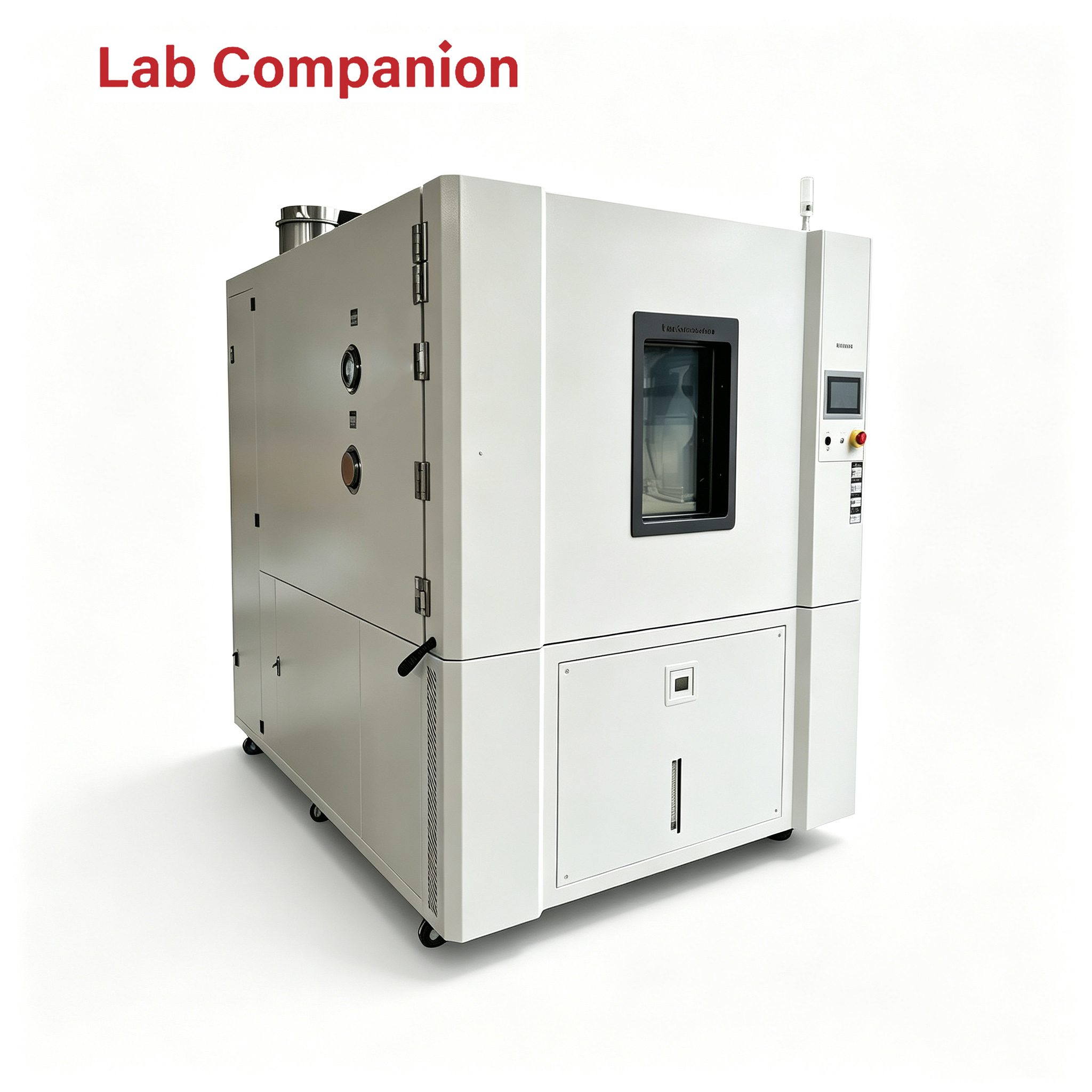
To meet full-chain temperature reliability verification requirements from CPO optical engines to complete switching systems, Lab Companion has built a complete device-level to system-level equipment portfolio.
Optical Engine & Module-level Solutions
The TC Series rapid thermal cycling test chambers feature a standard temperature range of -70℃ ~ +150℃ and support rapid thermal cycling from -55℃ ~ +125℃. Five grades of loaded actual temperature ramp rates are available: 5℃/min, 10℃/min, 15℃/min, 20℃/min and 25℃/min, supporting both linear and non-linear thermal cycling modes. Within the core test range of -40℃ ~ +85℃, temperature fluctuation ≤ ±0.3℃ and temperature deviation ≤ ±2℃, satisfying the strict GR-468-CORE requirements for thermal ramp linearity and chamber temperature uniformity. Targeting the small size, high integration and high heat density of CPO optical engines, compact TC chambers deliver high-speed temperature change and excellent temperature uniformity within a small cavity. Multi-layer sample racks can be equipped to perform parallel screening of tens to hundreds of optical engines in a single batch, matching mass-production test takt time.
Switching System & Complete Machine-level Solutions
Walk-in rapid thermal cycling test chambers cover volumes from 1000L to 10000L, with mechanical load capacity up to 1000kg, supporting maximum self-heating of 50kW for DUTs. Temperature range: -20℃ ~ +55℃, temperature ramp rate ≥5℃/min. The chambers can accommodate full CPO switch systems or server racks, enabling temperature cycling reliability verification under full-load operating conditions of complete machines.
Production Line Adaptation & Full-process Data Traceability
CPO mass production testing demands full traceable data. Both TC Series and Walk-in chambers are equipped with industrial touch controllers, supporting custom thermal cycle programming, real-time collection and storage of thermal curves, ramp rates, dwell duration and other key metrics. RS485 and Ethernet interfaces come as standard; OPC UA and Modbus TCP protocols are optional to connect with factory MES systems and build a full quality traceability chain.
VI. Second Half of CPO Industry: Reliability Determines Competition
CPO is gradually entering the mass production window, marking optical interconnection technology moving from lab validation to large-scale manufacturing. For reliability engineers in optical communication and AI computing infrastructure industries, the real competition has just begun. Solving a series of reliability challenges — insertion loss control at interfaces, yield stacking loss of optical engines, maintainability of packaged complete machines, and optical parameter stability under temperature cycling — determines how far CPO products can go from “manufacturable” toward “reliable large-scale commercialization”.
From device-level rapid thermal cycling screening of optical engines to large-space loaded reliability verification of complete switch systems, Lab Companion (Guangdong Hongzhan Technology) provides integrated temperature reliability verification equipment covering device, module and complete machine for CPO manufacturers, with TC Series rapid thermal cycling chambers and Walk-in test chambers as core products. Industry forecasts project CPO penetration will rise from approximately 0.5% in 2026 to 35% by 2030. Well-equipped and reliable test equipment forms the fundamental foundation to guarantee long-term product quality.


 Obtenez un devis
 Réseau IPv6 pris en charge