Envoyez-nous un email :
info@labcompanion.cn
-

-

Demander un appel :
+86 18688888286

1. Demands for Long-Duration Continuous Server Operation Testing
1.1 24/7 Server Operation Demands High Endurance from Test Equipment
High-power servers deployed in data centers require stable 24/7 continuous operation. Long-term exposure to ambient temperature fluctuations and gradual heat dissipation degradation leads to cumulative thermal stress, causing component aging, performance drift, and unexpected hardware failures. For AI training servers, continuous full-load tasks can last for days or even weeks, resulting in severe heat accumulation and accelerated component fatigue.
Short-term functional verification cannot fully reflect real-world server reliability. Long-duration high-temperature continuous testing is essential to expose latent defects triggered by prolonged thermal stress. In such reliability validation scenarios, the long-term operational stability of the test chamber directly determines the accuracy and credibility of test data.
1.2 Industry Standards for Long-Term High-Temperature Aging Testing
High-temperature aging testing is a mandatory reliability procedure for server systems. Servers are placed in a constant high-temperature environment of +40℃ to +55℃ and run full-load stress tests on CPUs, memory, and storage devices. Standard test durations range from 48 to 72 hours, while reliability growth tests can extend to hundreds of hours.
GB/T 2423.2-2018 specifies a test temperature range of 40℃ to 85℃ for server motherboard high-temperature testing, with adjustable test durations from 24 hours to hundreds of hours and real-time performance monitoring requirements. GB/T 9813.3-2017 mandates a minimum server MTBF (Mean Time Between Failures) of 10,000 hours, requiring 168 hours of fault-free full-load continuous operation.
These industry standards strictly require environmental test equipment to maintain precise and stable temperature output during ultra-long continuous operation.
2. Core Technical Advantages of Lab Companion High-Low Temperature Test Chambers for Long-Duration Operation
2.1 Superior Long-Term Temperature Field Stability
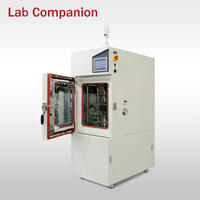
Lab Companion high-low temperature test chambers feature a wide temperature range of -70℃ to +150℃, with a temperature fluctuation of 0.5℃ and a temperature deviation of ±2℃. While precise temperature control is easy to achieve in short-term tests, maintaining zero drift during hundreds of hours of continuous operation requires systematic optimized design.
Equipped with the C100 PID + fuzzy logic control system, the chamber supports automatic self-checking, linear temperature and humidity calibration, and intelligent automatic shutdown. The balanced temperature and humidity control strategy precisely matches heating and cooling output, effectively reducing frequent compressor startup and shutdown and ensuring long-term operational stability.
The standard heating rate is approximately 3℃/min (20℃ to +150℃), and the cooling rate is 1.2℃/min (20℃ to -70℃). The chamber can operate stably for hundreds of hours continuously with consistent temperature distribution across the entire test cavity, ensuring uniform thermal stress for all test samples.
2.2 Long-Life Core Component Design for Continuous Workloads
To adapt to ultra-long uninterrupted testing scenarios, Lab Companion adopts high-reliability industrial-grade configurations. Key models are equipped with dual-compressor redundant design (one working, one standby), which automatically switches units in case of single compressor failure to avoid test interruption.
Built-in soft start and soft stop protection avoids instantaneous current impact; a 3-minute compressor delay protection mechanism effectively extends component service life. The inner chamber adopts SUS304 stainless steel, and all sealing parts use high and low temperature resistant silicone rubber materials, providing excellent aging resistance for long-cycle testing.
2.3 Strict Factory Endurance Verification
All Lab Companion test chambers undergo full-load aging tests before delivery to simulate the harshest on-site working conditions. New product models complete more than 1,000 hours of reliability endurance testing, and all finished products pass 72-hour continuous operation, temperature uniformity, and safety protection verification.
Internal test data shows that after simulated 3-year uninterrupted operation tests, the temperature rate attenuation is ≤5% and the temperature accuracy attenuation is ≤0.1℃, far better than the industry average of 15%. The redundant system design increases the MTBF by 2.5 times compared with traditional single-unit equipment under 3,000-hour continuous operation conditions.
3. Practical Testing Solutions for High-Power Server Long-Duration Operation
3.1 Standard High-Temperature Continuous Test Procedures
Place the server unit inside the test chamber and raise the temperature to the target value (55℃ or 70℃ typical) at a rate no more than 1℃/min. Start formal timing after the internal temperature field stabilizes. Keep the server running full-load stress programs throughout the test, and continuously monitor CPU/GPU temperature, power consumption, fan speed, and system logs.
Lab Companion chambers support scheduled startup and automatic timed shutdown, enabling unattended long-cycle testing and avoiding energy waste and idle operation risks.
3.2 Key Control Factors for Long-Cycle Testing
Consistent Temperature Uniformity for Multi-Server Parallel Testing
Large-capacity models (600L/1000L/1500L) support simultaneous testing of multiple server units. With a temperature uniformity within ±2.0℃, the chamber ensures identical thermal stress conditions for all samples during long-duration batch testing.
Traceable Test Data Records
The system automatically records full-process temperature curves and alarm logs, supporting complete data review and abnormal cause analysis after long-cycle testing, ensuring test authenticity and repeatability.
Multi-Layer Hardware Protection Prevents Test Interruption
Independent over-temperature protectors, mechanical pressure switches, and thermal relays provide hardware-level safety isolation, responding within milliseconds to avoid equipment failure and test data loss during hundred-hour continuous tests.
4. Conclusion
Lab Companion high-low temperature test chambers deliver reliable, stable, and repeatable environmental simulation for high-power server high-temperature aging and long-duration reliability verification. With a wide temperature range of -70℃ to +150℃, precise temperature control accuracy, and industry-leading long-term operational stability, the equipment fully meets standard 48–72 hour aging tests and ultra-long reliability growth tests of hundreds or thousands of hours.
As a professional environmental test equipment brand, Lab Companion provides global customers with standardized equipment and customized reliability test solutions for server, electronics, and semiconductor industries.


 Obtenez un devis
 Réseau IPv6 pris en charge